
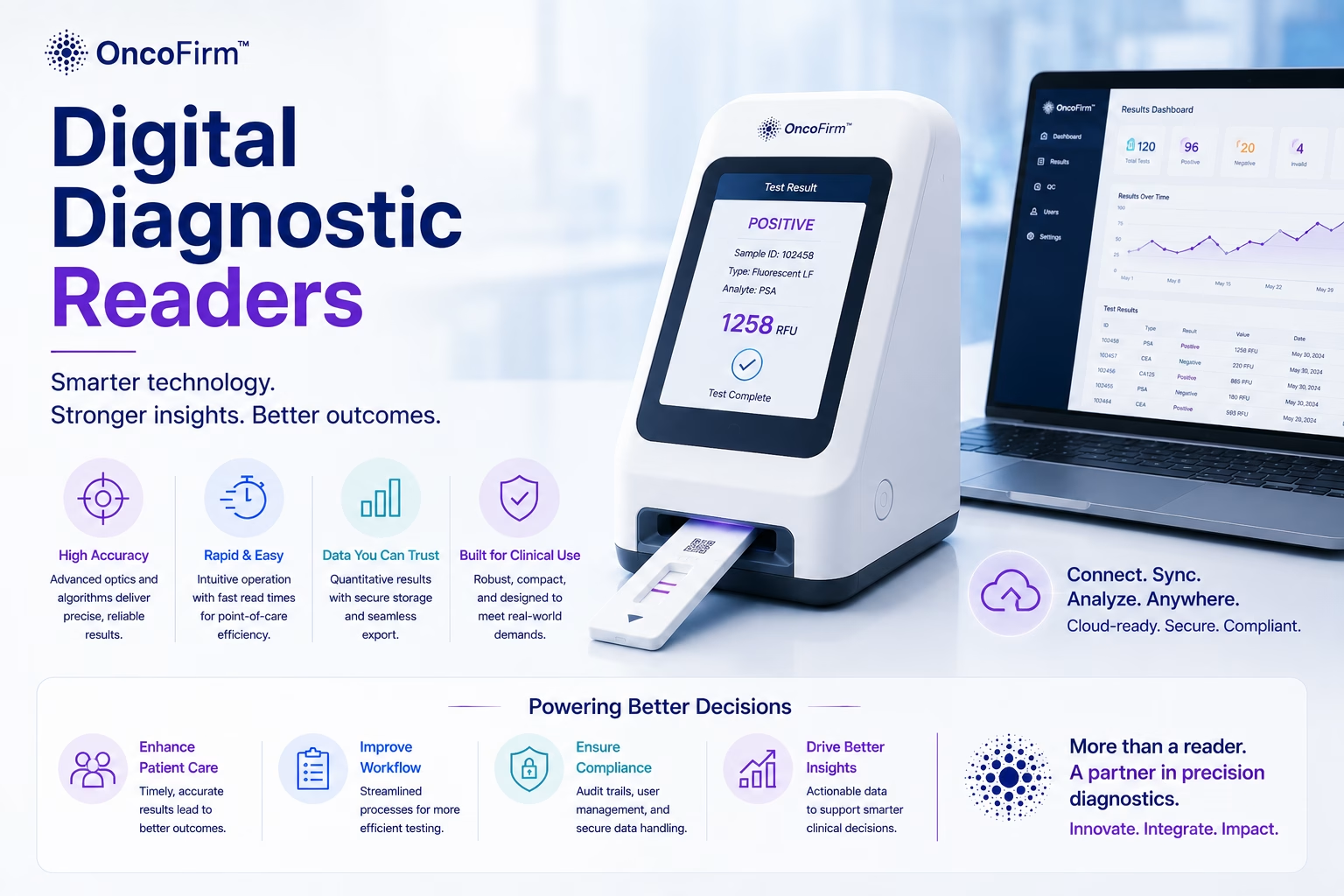
Digital Diagnostic Readers | OncoFirm™ Technology Platform
Digital Diagnostic Readers: Intelligent Signal Analysis for Next-Generation Cancer Diagnostics
Digital Diagnostic Readers
Intelligent Digital Analysis for Advanced Cancer Biomarker Detection
The evolution of diagnostic technology extends beyond assay chemistry. Modern cancer diagnostics increasingly depend on digital systems capable of accurately measuring biological signals, standardizing result interpretation, and integrating laboratory data into connected healthcare environments.
At OncoFirm™, we are developing Digital Diagnostic Readers designed to complement our fluorescence-based immunodiagnostic platform. These readers combine precision optics, digital signal processing, software analytics, and future AI integration to support standardized analysis of cancer-associated biomarkers.
By transforming optical signals into structured digital data, our platform is designed to reduce subjective interpretation while supporting scalable, data-driven diagnostic workflows.
What Is a Digital Diagnostic Reader?
A digital diagnostic reader is an electronic instrument that measures and analyzes signals generated by diagnostic assays.
Unlike visually interpreted rapid tests, digital readers use optical sensors and analytical software to quantify biological signals with high consistency.
Digital readers may be used with:
- Fluorescent lateral flow assays
- Optical immunoassays
- Multiplex biomarker panels
- Quantitative rapid diagnostic tests
- Research assays
- Laboratory-developed assays
Depending on the assay design and intended use, digital readers can provide qualitative, semi-quantitative, or quantitative outputs.
Why Digital Readers Matter
Traditional visually interpreted diagnostic tests rely on the human eye to identify changes in color intensity.
Although this approach is practical and cost-effective, visual interpretation may introduce variability, particularly when biomarker concentrations are low or signal intensity is subtle.
Digital readers are designed to:
- Capture optical signals objectively
- Standardize result interpretation
- Improve reproducibility
- Store digital records
- Support quality assurance
- Enable software-assisted analysis
These capabilities are increasingly important as cancer diagnostics become more precise and data-driven.
How Digital Diagnostic Readers Work
Digital readers combine hardware and software to transform optical information into clinically meaningful data.
Step 1 – Assay Completion
A biological sample is analyzed using a compatible immunodiagnostic assay, such as a fluorescent lateral flow test.
Step 2 – Optical Signal Acquisition
The reader illuminates the test region using a controlled light source appropriate for the fluorescent label.
Step 3 – Signal Detection
Optical sensors measure emitted fluorescence and convert the light into electronic signals.
Step 4 – Digital Processing
Embedded software processes the raw signal, applies calibration algorithms, performs quality checks, and generates standardized analytical outputs.
Step 5 – Data Reporting
Results may be displayed locally, stored securely, exported to laboratory systems, or integrated into cloud-based diagnostic platforms, depending on the system configuration.
Platform Components
Precision Optical System
The optical subsystem is designed to:
- Deliver controlled excitation light
- Minimize background interference
- Capture fluorescence consistently
- Support repeatable measurements
Stable optical performance is essential for reliable signal detection.
High-Sensitivity Sensors
Digital readers employ optical detectors capable of measuring low-intensity fluorescence signals generated by compatible immunoassays.
Sensor performance influences:
- Signal resolution
- Dynamic range
- Measurement reproducibility
- Analytical precision
Embedded Software
Analytical software performs multiple functions, including:
- Signal normalization
- Calibration
- Quality control
- Data processing
- Result calculation
- User interface management
Software updates may support future feature enhancements while maintaining system consistency.
Connectivity
Modern diagnostic readers increasingly support digital interoperability.
Potential capabilities include:
- Laboratory Information System (LIS) integration
- Electronic Health Record (EHR) compatibility
- Secure cloud connectivity
- Data export
- Remote software updates
- Audit trails
These features facilitate integration into contemporary clinical and laboratory workflows.
Fluorescent Signal Measurement
OncoFirm’s platform is designed to operate with fluorescence-based immunodiagnostic assays.
Compared with visually interpreted tests, fluorescence measurement enables digital capture of signal intensity for objective analysis.
Potential advantages include:
- Standardized measurements
- Reduced observer variability
- Quantitative or semi-quantitative reporting
- Multiplex assay compatibility
- AI-ready digital datasets
The analytical characteristics of each assay depend on validation for its intended use.
Artificial Intelligence Integration
Digital readers generate structured datasets suitable for computational analysis.
Future AI-assisted capabilities may include:
- Automated signal interpretation
- Background correction
- Image quality assessment
- Trend analysis
- Quality assurance monitoring
- Decision-support tools
- Predictive analytics
Artificial intelligence is intended to assist healthcare professionals while maintaining appropriate human oversight.
Applications in Early Cancer Diagnostics
Digital readers are being developed to support immunodiagnostic applications involving cancer-associated biomarkers.
Potential applications include:
- Tumor antigen detection
- Multiplex biomarker analysis
- Point-of-care oncology
- Translational research
- Clinical laboratory workflows
- Biomarker validation studies
When integrated with validated assays, digital readers can contribute standardized analytical data that complements imaging, pathology, and molecular diagnostics.
Designed for Point-of-Care Healthcare
Portable digital readers expand opportunities for decentralized testing by combining compact instrumentation with advanced analytical capabilities.
Potential deployment environments include:
- Physician offices
- Oncology clinics
- Community healthcare centers
- Mobile screening programs
- Academic research laboratories
- Resource-limited healthcare settings
These systems are designed to complement centralized laboratory services and support broader access to diagnostic technologies.
Data Security and Quality
Reliable diagnostics require more than analytical performance.
Digital diagnostic systems should also support:
- Secure data management
- User authentication
- Instrument calibration
- Quality control verification
- Audit logging
- Software validation
- Regulatory documentation
These capabilities contribute to consistent and traceable diagnostic workflows.
Research and Development
OncoFirm’s Digital Diagnostic Reader development strategy integrates expertise in:
- Optical engineering
- Embedded electronics
- Biomedical software
- Immunodiagnostics
- Fluorescence detection
- Artificial intelligence
- Data science
- Human-centered device design
Our multidisciplinary approach supports the development of scalable technologies aligned with the future of precision diagnostics.
Integration with the OncoFirm Technology Platform
The Digital Diagnostic Reader is designed as a central component of the OncoFirm diagnostic ecosystem.
It complements:
- Antigen Technology
- Fluorescent Lateral Flow Platform
- AI-Assisted Diagnostic Software
- Multiplex Biomarker Detection
- Point-of-Care Diagnostic Solutions
- Cloud-Based Data Management
Together, these technologies are intended to create an integrated platform for rapid, standardized, and data-driven cancer diagnostics.
Frequently Asked Questions
What is a digital diagnostic reader?
A digital diagnostic reader is an electronic instrument that measures optical signals produced by compatible diagnostic assays and converts them into standardized digital results.
Why use a digital reader instead of visual interpretation?
Digital readers reduce subjective interpretation by measuring optical signals objectively, improving consistency and supporting standardized workflows.
Can digital readers analyze fluorescent assays?
Yes. Fluorescent diagnostic readers are specifically designed to measure fluorescence emitted by labeled biomarkers using calibrated optical systems.
Does artificial intelligence replace clinical interpretation?
No. AI is intended to support data analysis and workflow efficiency. Clinical decisions should always be made by qualified healthcare professionals based on the complete clinical context.
Conclusion
Digital diagnostic readers are becoming an essential component of modern immunodiagnostics by transforming biological signals into objective, standardized digital data. As fluorescence-based assays, multiplex biomarker detection, and AI-assisted analytics continue to evolve, these systems will play an increasingly important role in early cancer diagnostics, point-of-care testing, and precision oncology.
At OncoFirm™, we are developing Digital Diagnostic Readers that integrate advanced optics, intelligent software, and scalable connectivity with our fluorescence-based antigen detection platform. Through continued innovation and rigorous validation, our goal is to support more consistent, efficient, and data-driven approaches to cancer biomarker analysis.
Key Technology Features
- Precision fluorescence detection
- Advanced optical signal measurement
- High-sensitivity digital sensors
- AI-ready software architecture
- Automated quality control
- Multiplex assay compatibility
- Secure digital data management
- Cloud and LIS integration
- Point-of-care deployment potential
- Scalable diagnostic platform
Suggested Internal Links
Technology Pages
- Antigen Technology
- Fluorescent Lateral Flow Platform
- AI-Assisted Diagnostics
- Biomarker Discovery
- Research & Development
Supporting Articles
- How Lateral Flow Assays Work
- Fluorescent vs. Gold Nanoparticle Assays
- AI in Cancer Diagnostics
- Point-of-Care Oncology
- Tumor Antigen Detection
- Latest Rapid Diagnostic Technologies
- What Are Cancer Biomarkers?
- Future of Cancer Screening
Suggested Peer-Reviewed References
- Posthuma-Trumpie GA, Korf J, van Amerongen A. Lateral Flow (Immuno)Assay: Its Strengths, Weaknesses, Opportunities and Threats. Analytical and Bioanalytical Chemistry. 2009.
- Bahadır EB, Sezgintürk MK. Lateral Flow Assays: Principles, Designs and Labels. Trends in Analytical Chemistry. 2016.
- Quesada-González D, Merkoçi A. Nanoparticle-Based Lateral Flow Biosensors. Biosensors and Bioelectronics. 2015.
- Topol EJ. High-Performance Medicine: The Convergence of Human and Artificial Intelligence. Nature Medicine. 2019.
- National Cancer Institute (NCI). Cancer Biomarkers and Early Detection Research.
- U.S. Food and Drug Administration (FDA). Software as a Medical Device (SaMD) and In Vitro Diagnostic Device Guidance.
- World Health Organization (WHO). Essential In Vitro Diagnostics List.
- National Comprehensive Cancer Network (NCCN). Clinical Practice Guidelines in Oncology.